Hostscan - PHP tool for scanning specific range of hosts

Hostscan-PHP-tool-for-scanning-specific-range-of-hosts
Hostscan is a php tool which allows you to scan specific range of hosts, mostly for information gathering and testing for weak passwords. I guess it's a pentest tool, i'd created it to automate some tests that i often do. Since it's PHP, it works quite slowly compared to client-side soft.

How it works?

  • You need to provide range of ip's (e.g. 127.0.0.1 - 127.0.0.10); program will perform operations on each address separately, basing on selected options, then it will print out the response.
  • By default, program will only check open ports, print http response headers, test for HTTP methods and check FTP for anonymous login.
  • If 'SSH/IMAP/DB's' are checked, program will try to bruteforce SSH,IMAP,MySQL,PostgreSQL & MsSQL using array of passwords and users defined on the beggining of script. Notice, that it will try to login as user with grand permissions (e.g. root, postgres), although you're able to edit it.
  • If 'FTP User' is set, program will also try to bruteforce FTP with specific user using mentioned passwords array. By default it's not, and it will only test for anonymous login.
  • If 'Deep Scan' is set, program will perform all aforementioned operations. Further, it will use nmap with specific parameters you're able to edit, also, the traceroute scan will be performed and displayed - just like nmap. Deep Scan also gather some useful informations about a website (if it's running), such as interesting files/folders and www title.
  • ?url=website.com for quick IP address of specific website....so - what it does it do? Nmap, traceroute, port scan, ftp anonymous login, ftp/ssh/imap/mysql/pgsql/mssql bruteforce, http (website) info gathering, Crawler accepts as a parameter array of files and folders that you can manually edit, just like others options.

Download Hostscan

Hook Analyser 3.1 - Malware Analysis Tool

hook-analyser-31-malware-analysis-too
Hook Analyser is a freeware application which allows an investigator/analyst to perform “static & run-time / dynamic” analysis of suspicious applications, also gather (analyse & co-related) threat intelligence related information (or data) from various open sources on the Internet.

Essentially it’s a malware analysis tool that has evolved to add some cyber threat intelligence features & mapping.

Hook Analyser is perhaps the only “free” software in the market which combines analysis of malware analysis and cyber threat intelligence capabilities. The software has been used by major Fortune 500 organisations.

Features/Functionality

  • Spawn and Hook to Application – Enables you to spawn an application, and hook into it
  • Hook to a specific running process – Allows you to hook to a running (active) process
  • Static Malware Analysis – Scans PE/Windows executables to identify potential malware traces
  • Application crash analysis – Allows you to analyse memory content when an application crashes
  • Exe extractor – This module essentially extracts executables from running process/s


Download Hook Analyser 3.1

ProduKey - Recover lost Windows product key (CD-Key) and Office 2003/2007 product key

ProduKey-Recover-lost-Windows-product-key-and-Office-2003-2007-product-key
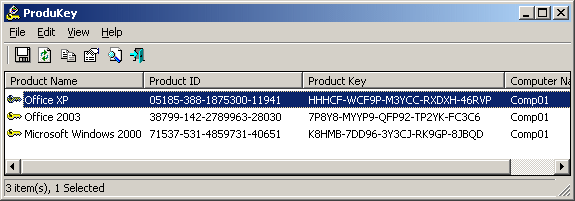
ProduKey is a small utility that displays the ProductID and the CD-Key of Microsoft Office (Microsoft Office 2003, Microsoft Office 2007), Windows (Including Windows 7 and Windows Vista), Exchange Server, and SQL Server installed on your computer. You can view this information for your current running operating system, or for another operating system/computer - by using command-line options. This utility can be useful if you lost the product key of your Windows/Office, and you want to reinstall it on your computer.

Download ProduKey

OWASP OWTF – Offensive (Web) Testing Framework

owasp-owtf-offensive-web-testing-framework
The purpose of this tool is to automate the manual, uncreative part of pen testing: For example, spending time trying to remember how to call "tool X", parsing results of "tool X" manually to feed "tool Y", etc.
By reducing this burden I hope pen testers will have more time to:

  • See the big picture and think out of the box
  • More efficiently find, verify and combine vulnerabilities
  • Have time to investigate complex vulnerabilities like business logic/architectural flaws or virtual hosting sessions
  • Perform more tactical/targeted fuzzing on seemingly risky areas
  • Demonstrate true impact despite the short timeframes we are typically given to test.

Some features like the passive and semi_passive test separation may also assist pen testers wishing to go the extra mile to get a head start and maybe even legitimately start report writing or preparing attacks before they are given the green light to test.
The tool is highly configurable and anybody can trivially create simple plugins or add new tests in the configuration files without having any development experience. Please share your tests with the community! :)
This tool is however not a silverbullet and will only be as good as the person using it: Understanding and experience will be required to correctly interpret tool output and decide what to investigate further in order to demonstrate impact.

Features

  • OWASP Testing Guide-oriented: owtf will try to classify the findings as closely as possible to the OWASP Testing Guide
  • Report updated on the fly: As soon as each plugin finishes or sometimes before (i.e. after each vulnerability scanner finishes)
  • "Scumbag spidering": Instead of implementing yet another spider (a hard job), owtf will scrub the output of all tools/plugins run to gather as many URLs as possible. This is somewhat "cheating" but tremendously effective since it combines the results of different tools, including several tools that perform brute forcing of files and directories.
  • Resilience: If one tool crashes owtf will move on to the next tool/test, saving the partial output of the tool until it crashed
  • Easy to configure: config files are easy to read and modify
  • Easy to run: No strange parameters, DB setup requirements, libraries, complex dependencies, etc
  • Full control of what tests to run, interactivity and hopefully easy to follow examples and help :)
  • Easy to review transaction logs and plain text files with URLs, simple for scripting
  • Basic Google Hacking without (annoying) API Key requirements via "blanket searches", trying a bunch of operators at once, you can then narrow the search down if you find something interesting.
  • Easy to extract data from the database to parse or pass to other tools: They are all text files

Requirements

  • Linux (any Ubuntu derivative should work just fine) and python 2.6.5 or greater
  • Latest Kali version not required but helpful (almost 0 setup time)
  • You do NOT have to have all tools installed: owtf will move on with an error for the missing tools

Download OWASP OWTF

WebSiteSniffer - captures all Web site files downloaded by your Web browser while browsing the Internet

websitesniffer-captures-all-web-site
WebSiteSniffer is a packet sniffer tool that captures all Web site files downloaded by your Web browser while browsing the Internet, and stores them on your hard drive under the base folder that you choose. WebSiteSniffer allows you to choose which type of Web site files will be captured: HTML Files, Text Files, XML Files, CSS Files, Video/Audio Files, Images, Scripts, and Flash (.swf) files.

While capturing the Web site files, the main window of WebSiteSniffer displays general statistics about the downloaded files for every Web site / host name, including the total size of all files (compressed and uncompressed) and total number of files for every file type (HTML, Text, Images, and so on)

Download WebSiteSniffer

Parsero v0.75 - Attacking Robots.txt Files

parsero-v075-attacking-robotstxt-files
Parsero is a free script written in Python which reads the Robots.txt file of a web server and looks at the Disallow entries. The Disallow entries tell the search engines what directories or files hosted on a web server mustn't be indexed. For example, "Disallow: /portal/login" means that the content on www.example.com/portal/login it's not allowed to be indexed by crawlers like Google, Bing, Yahoo... This is the way the administrator have to not share sensitive or private information with the search engines.
But sometimes these paths typed in the Disallows entries are directly accessible by the users without using a search engine, just visiting the URL and the Path, and sometimes they are not available to be visited by anybody... Because it is really common that the administrators write a lot of Disallows and some of them are available and some of them are not, you can use Parsero in order to check the HTTP status code of each Disallow entry in order to check automatically if these directories are available or not.

Also, the fact the administrator write a robots.txt, it doesn't mean that the files or directories typed in the Dissallow entries will not be indexed by Bing, Google, Yahoo... For this reason, Parsero is capable of searching in Bing to locate content indexed without the web administrator authorization. Parsero will check the HTTP status code in the same way for each Bing result.

When you execute Parsero, you can see the HTTP status codes. For example, the codes bellow:

200 OK          The request has succeeded.
403 Forbidden   The server understood the request, but is refusing to fulfill it.
404 Not Found   The server hasn't found anything matching the Request-URI.
302 Found       The requested resource resides temporarily under a different URI.
...

Usage

$ python3 parsero.py -h

usage: parsero.py [-h] [-u URL] [-o] [-sb]

optional arguments:
-h, --help  show this help message and exit
-u URL      Type the URL which will be analyzed
-o          Show only the "HTTP 200" status code
-sb         Search in Bing indexed Disallows

Download Parsero v0.75

OWASP ZAP v2.3.1 - An easy to use integrated penetration testing tool for finding vulnerabilities in web applications

owasp-zap-v231-easy-to-use-integrated
OWASP Zed Attack Proxy (ZAP) An easy to use integrated penetration testing tool for finding vulnerabilities in web applications. It is designed to be used by people with a wide range of security experience and as such is ideal for developers and functional testers who are new to penetration testing as well as being a useful addition to an experienced pen testers toolbox.

Changelog v2.3.1

The following changes were made in this release:

  • ZAP changes request data (while switching views) ( Issue 81 )
  • Unfulfilled dependencies hang the active scan ( Issue 377 )
  • Cant remove scripts marked as ‘load on start’ ( Issue 1073 )
  • core.newSession doesn’t clear Sites ( Issue 1114 )
  • Historical Request Tab Doesn’t allow formatting changes ( Issue 1155 )
  • Proxy gzip decoder doesn’t update content length in response headers ( Issue 1156 )
  • Unable to set a home directory with a space on the command line ( Issue 1163 )
  • Redundant indexes in zapdb.script ( Issue 1166 )
  • Add proxy support for “deflate” content encoding ( Issue 1168 )
  • Spider Context/User pop up menus no longer shown ( Issue 1170 )
  • Unable to select 2 requests in fuzz results (Ctrl + click) ( Issue 1179 )
  • Vulnerable pages active scanned only once ( Issue 1181 )
  • Alerts of same type for different parameters of same vulnerable page shown only once in “Alerts” tree ( Issue 1182 )
  • NullPointerException while selecting a node in the “Alerts” tab after deleting a message ( Issue 1183 )
  • Cmdline session params have no effect ( Issue 1191 )
  • Scan URL path elements – turn off by default ( Issue 1193 )
  • Command line arguments are not passed to extensions when starting ZAP in daemon mode ( Issue 1194 )
  • AbstractPlugin.bingo incorrectly sets evidence to attack ( Issue 1196 )
  • Issue with loading addons that did not initialize correctly ( Issue 1202 )
  • WordPress Authentication Script ( Issue 1203 )
  • ‘History’ tab is not cleared when a new session is created through the API with ZAP in GUI mode ( Issue 1206 )

Download OWASP ZAP v2.3.1